
CMTA Warns of Rs. 40 Billion Revenue Loss, Calls for Fairer Vehicle Tax Rules
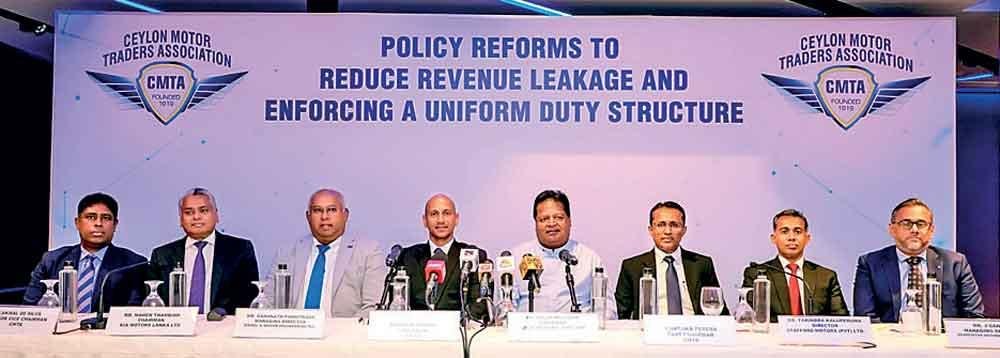
From left: David Pieris Motor Company Lanka Ltd Chief Officer Vehicle Sales Lakmal De Silva, Kia Motors Lanka Ltd Chairman Mahen Thambiah, Diesel & Motor Engineering PLC Managing Director Gahanath Pandithage, CMTA Chairman Andrew Perera, Ideal Motors (Pvt.) Ltd Chairman Nalin Welgama, United Motors Lanka PLC Group Chief Operating Officer Charaka Perera, Stafford Motors (Pvt.) Ltd Director Tarindra Kaluperuma and Associated Motorways (Private) Limited Group Managing Director Jawahar Ganesh
The Ceylon Motor Traders’ Association (CMTA) has called on the Government to introduce greater transparency, consistency and fairness in Sri Lanka’s vehicle import and taxation policies, warning that existing valuation practices could result in significant revenue losses to the Treasury.
The association, which has represented Sri Lanka’s automotive industry since 1919 and is affiliated with the Ceylon Chamber of Commerce, said a sustainable vehicle import framework must create a level playing field for authorised vehicle importers, used-vehicle businesses and consumers.
The CMTA’s concerns come amid continued fiscal and regulatory pressure on the automotive sector, including the recent introduction of a 50 percent surcharge on vehicles. While acknowledging the Government’s need to manage foreign exchange, regulate imports and increase revenue, the association said such measures should not create unfair advantages or disproportionately affect legitimate businesses.
A key concern raised by the CMTA is the continued use of a blanket 15 percent depreciation applied to the cost, insurance and freight (CIF) value of used vehicle imports when calculating duties.
According to the association, this system can provide a significant tax advantage to certain used vehicles, even when they are virtually identical to brand-new vehicles in terms of model, specifications and, in some cases, mileage.
The CMTA estimates that the depreciation mechanism contributed to approximately Rs. 40 billion in lost government revenue during 2025. It warned that a similar level of revenue leakage could occur in 2026 if the current system remains unchanged.
At a time when the Government is working to strengthen public finances, the association said preventing avoidable revenue losses should be a key consideration when reviewing automotive taxation policies.
The CMTA stressed that its position is not aimed at restricting consumer choice or eliminating the used vehicle market. Instead, it is calling for vehicle taxation to be based on fair and consistent valuation principles.
The association argues that when two vehicles with substantially similar specifications can face different levels of taxation simply because one was previously registered overseas, the resulting disparity requires policy reconsideration.
The CMTA also highlighted the potential impact of the 50 percent surcharge on the wider automotive industry. According to the association, higher costs could affect vehicle prices, consumer affordability, business viability and employment across the sector.
Authorised vehicle importers, it noted, make significant investments in showrooms, service centres, technical equipment, employee training and after-sales support. These businesses also contribute to government revenue through taxes, customs duties, EPF, ETF and other statutory payments.
The association said these wider economic contributions should be taken into account when designing automotive policies.
It warned that placing a disproportionate burden on compliant businesses while allowing other market segments to benefit from valuation concessions could weaken the formal automotive ecosystem and ultimately affect consumers.
The CMTA has previously proposed replacing the blanket 15 percent depreciation system with a structured mechanism based on the actual age of the vehicle. Under its earlier proposal, depreciation would follow a defined scale and be capped at 10 percent.
The association believes such a system would provide greater transparency, better reflect the actual depreciation of vehicles and reduce opportunities for abuse.
If depreciation concessions for used vehicle imports are retained, the CMTA said they should be linked to objective criteria such as vehicle age and implemented through clearly defined and consistently applied rules.
The association also called for vehicle valuations to reflect genuine transaction values so that businesses operating within the same market are subject to equitable taxation.
Beyond government revenue, the CMTA said a fair taxation system is also important for consumers. Vehicles purchased through authorised distributors generally provide manufacturer warranties, structured after-sales services and access to genuine spare parts, offering consumers greater reliability and support.
The association is therefore urging policymakers to review Sri Lanka’s automotive taxation and import regulations as a whole rather than addressing individual market segments separately.
It said the ultimate objective should be to establish a transparent and competitive framework covering new vehicles, used imports, authorised distributors, independent businesses and consumers.
According to the CMTA, greater consistency in vehicle valuation and taxation would reduce opportunities for exploitation while improving predictability for businesses and strengthening government revenue.
As Sri Lanka continues efforts to rebuild its economy and improve public finances, the association believes automotive policy should be guided by a fundamental principle of equal treatment across the industry.
The CMTA said removing unjustified valuation advantages, reviewing the impact of major surcharges and introducing transparent rules based on genuine vehicle values would help create a more sustainable automotive sector.
Ultimately, the association maintains that a healthy automotive industry should be based not on which segment receives the greatest advantage, but on whether all legitimate participants operate under fair, transparent and consistently applied rules.