Sri Lanka–Vietnam Business Council Targets US$ 1 Billion Bilateral Trade by 2030
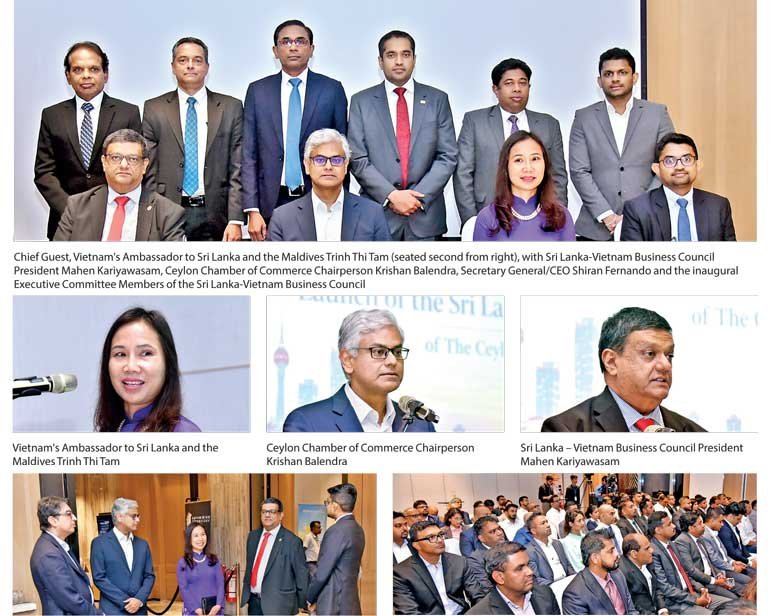
COLOMBO, October 16, 2026 — The Ceylon Chamber of Commerce has launched the Sri Lanka–Vietnam Business Council to strengthen bilateral trade, investment and tourism ties, supporting an ambitious target of increasing annual trade between the two countries to US$ 1 billion by 2030.
The new council, the 22nd bilateral business council established under the Ceylon Chamber, has attracted 30 inaugural members, reflecting growing private-sector interest in Vietnam as an emerging market for Sri Lankan businesses.
The initiative comes as diplomatic relations between the two countries continue to strengthen, creating opportunities to expand commercial cooperation beyond existing levels.
The launch follows commitments made during Vietnamese Party General Secretary and State President Tô Lâm’s state visit to Sri Lanka in May, when a Sri Lanka–Vietnam Trade, Investment and Tourism Forum brought together government and business representatives from both countries.
Ceylon Chamber of Commerce Chairperson Krishan Balendra said the council would provide a structured platform to translate diplomatic progress into practical business partnerships.
“This is an important milestone in the growing economic partnership between our two countries,” he said, highlighting the council’s role in facilitating trade, promoting investment, encouraging knowledge-sharing and strengthening private-sector engagement.
Trade Target Highlights Untapped Potential
Despite more than 55 years of diplomatic relations and the recent elevation of bilateral ties to a Comprehensive Partnership, trade between Sri Lanka and Vietnam has yet to exceed US$ 500 million in any recent year, according to Vietnamese Ambassador to Sri Lanka Trinh Tam.
The gap between current trade levels and the US$ 1 billion target by 2030 highlights the potential for stronger commercial engagement between the two economies.
The Ambassador said closer government-to-government relations would need to be supported by stronger connections between businesses and people to achieve the target.
She identified the new council as a mechanism for companies to exchange market information, identify commercial opportunities and establish partnerships capable of generating measurable economic benefits.
Balendra pointed to Vietnam’s rapid economic transformation and its emergence as a major manufacturing, logistics and investment hub in Asia as important reasons for Sri Lankan companies to explore the market more actively.
Potential areas for cooperation include manufacturing, agriculture, logistics, tourism, information and communications technology, renewable energy and professional services.
He also highlighted Sri Lanka’s strategic location in the Indian Ocean, established services sector and tourism potential as advantages that could attract Vietnamese investors seeking partnerships and regional market access.
The Chamber’s earlier “Doing Business in Vietnam” event, held in October 2025, had generated considerable interest among Sri Lankan businesses, Balendra said, demonstrating an appetite to explore opportunities in one of Asia’s rapidly growing economies.
Direct Flights Support Business Connectivity
Improved air connectivity is emerging as an important enabler of stronger trade and investment relations.
Balendra noted that expanded services by Vietnam Airlines and Vietjet had made travel between the two countries more convenient for business representatives, investors and tourists.
According to Ambassador Trinh Tam, the commencement of direct services between Ho Chi Minh City and Colombo around two months earlier had already generated interest among Vietnamese businesses.
The Vietnamese Embassy had facilitated approximately 10 groups of Vietnamese businesspeople visiting Sri Lanka to explore market opportunities and promote their products, she said.
Although these engagements remain at an early stage, the visits indicate the potential for direct air links to support business-to-business networking, market development and commercial partnerships.
Greater connectivity could also help reduce practical barriers to trade delegations, investment discussions and tourism-related cooperation.
SMEs and Emerging Industries in Focus
The Ambassador urged the council to ensure that opportunities are accessible to small and medium-sized enterprises (SMEs), young entrepreneurs and businesses operating in emerging industries, rather than concentrating exclusively on large corporations.
She highlighted trade, investment, tourism, logistics, agriculture, food products and services as areas with potential for stronger collaboration.
The council’s effectiveness, she stressed, would depend on its ability to turn discussions into actual commercial projects.
Council President Mahen Kariyawasan similarly called for Sri Lanka and Vietnam to translate their longstanding diplomatic and cultural ties into tangible economic outcomes.
He said the council should prioritize business-to-business partnerships, trade delegations, investment promotion and platforms that allow entrepreneurs from both countries to collaborate.
Tourism, aviation, agriculture, manufacturing, technology and logistics were identified as priority sectors for cooperation.
Kariyawasan also emphasized the importance of an inclusive approach that would enable SMEs to participate alongside larger businesses and benefit from expanding bilateral relations.
From Diplomatic Relations to Commercial Growth
The establishment of the Sri Lanka–Vietnam Business Council reflects a broader effort to strengthen the economic dimension of the countries’ increasingly close relationship.
The council is expected to work with the Ceylon Chamber of Commerce, the two countries’ diplomatic missions, relevant government institutions and private-sector stakeholders to identify opportunities and address barriers to commercial engagement.
Balendra said growing business interest, institutional cooperation and improved air connectivity provided a promising foundation for the next phase of bilateral economic relations.
For Sri Lanka, deeper engagement with Vietnam could open additional opportunities for exporters, tourism operators, service providers and investors seeking access to regional markets. For Vietnamese businesses, Sri Lanka offers opportunities in trade, investment, services and regional connectivity.
Achieving the US$ 1 billion trade ambition by 2030 will require sustained business engagement, stronger market access and the development of commercially viable partnerships.
The new council aims to provide the institutional platform needed to turn those opportunities into measurable gains for both economies.