MF Projects Sri Lanka’s Economic Growth to Moderate to 3.7% in 2027
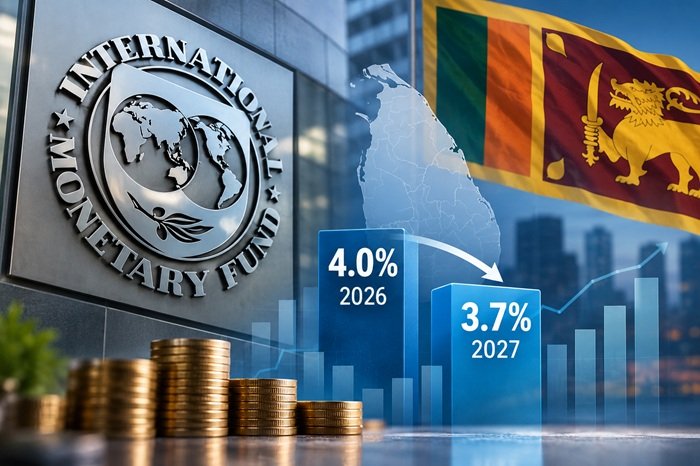
COLOMBO, October 13, 2026 — Sri Lanka’s economic growth is projected to ease to 3.7% in 2027 from an estimated 4% in 2026, according to the International Monetary Fund’s (IMF) latest World Economic Outlook, signalling a gradual moderation in the country’s recovery.
The IMF’s October 2026 report, titled World Economic Outlook: Resilience Under Strain, Urgent Choices, forecasts growth below the 5% expansion recorded in 2025. The projections point to continued economic expansion, but at a slower pace as Sri Lanka navigates inflationary pressures, external-sector challenges and an uncertain global economic environment.
Inflation and external-sector pressures
The IMF projects Sri Lanka’s inflation rate to rise to 5.3% in 2026 and 5.4% in 2027, following a negative inflation rate of 0.5% in 2025.
The outlook also indicates a shift in the country’s current account position. After recording a surplus equivalent to 1.6% of gross domestic product (GDP) in 2025, Sri Lanka is projected to post current account deficits of 0.5% of GDP in 2026 and 0.3% in 2027.
These projections highlight the importance of managing external-sector pressures as the economy continues its recovery. Developments in import demand, energy prices and export earnings will remain relevant to Sri Lanka’s external balance.
Meanwhile, the unemployment rate is forecast to remain stable at 3.9% in both 2026 and 2027, according to the report.
Global growth faces mounting uncertainty
The IMF expects global economic growth to moderate from 3.5% in 2025 to 3.1% in 2026 before improving to 3.4% in 2027.
The Fund noted that global economic activity has demonstrated resilience despite continuing conflict in the Middle East, trade tensions and rising energy costs. However, it cautioned that the outlook remains uneven, with economies facing different levels of exposure to energy-price shocks, geopolitical uncertainty and shifts in global demand.
Emerging markets and developing economies are projected to grow by 3.7% in 2026 before accelerating to 4.4% in 2027.
Among major economies, the United States is forecast to record growth of 2.3% in both 2026 and 2027. China’s economy is projected to expand by 4.5% in 2026, while India is expected to record stronger growth of 7%.
Energy costs and inflation remain key risks
Global inflation is projected to increase from 4.1% in 2025 to 4.7% in 2026 before easing to 4.1% in 2027. The IMF attributes the anticipated increase largely to higher energy and food prices.
The Fund warned that a prolonged conflict in the Middle East, disruptions to energy supplies, trade uncertainty and financial vulnerabilities could pose further risks to global economic stability.
For Sri Lanka, movements in global energy and food prices could have implications for domestic inflation, import expenditure and the current account. A weaker global growth environment could also affect external demand and trade conditions.
The IMF emphasised the need for countries to rebuild fiscal buffers, strengthen energy security and maintain sound economic policies to support sustainable growth.
For Sri Lanka, the latest projections underscore the challenge of sustaining the recovery while managing inflation and external-sector risks in an uncertain international environment.
Fullreport:https://www.imf.org/-/media/files/publications/weo/2026/october/english/text. pdf