Sri Lanka Courts Investors With Renewable Energy, Port Expansion and Rs. 2 Trillion Capital Spending Plan
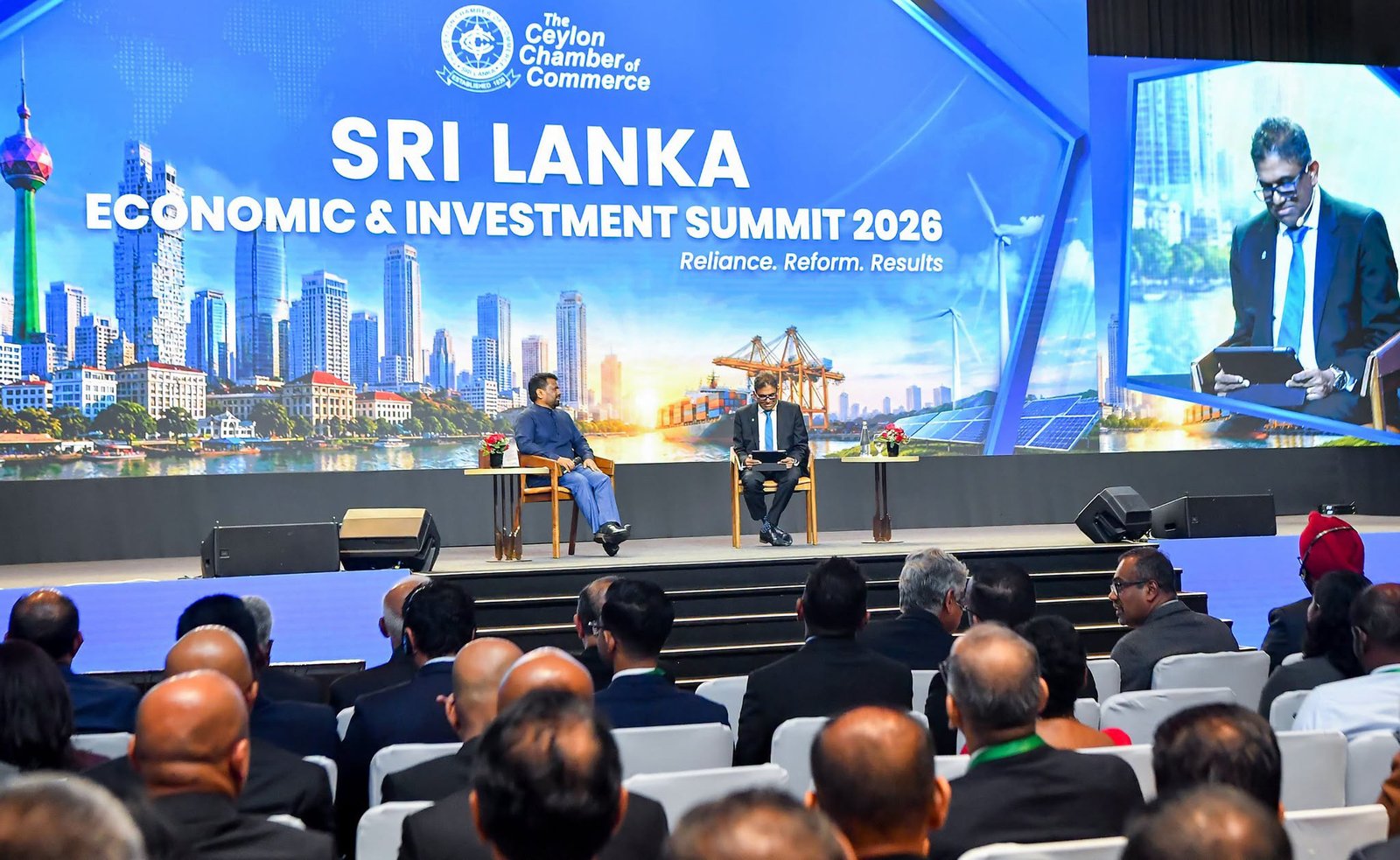
COLOMBO, October 14, 2026 — President Anura Kumara Dissanayake has outlined an investment-led economic strategy centred on renewable energy, port infrastructure, rural enterprise development and faster public-sector project execution, inviting local and international investors to capitalise on emerging opportunities in Sri Lanka.
Addressing the Sri Lanka Economic and Investment Summit 2026, organised by the Ceylon Chamber of Commerce in Colombo, the President said the Government was working to strengthen transparency, introduce investor-friendly laws and regulations, and develop the infrastructure required to support private investment and sustainable economic growth.
The summit brought together policymakers, business leaders and international investors to discuss foreign direct investment (FDI), export expansion and Sri Lanka’s position in a changing global economy.
Rs. 2 trillion capital expenditure plan targets project delivery
The President said the Government had planned Rs. 2 trillion in capital expenditure for the forthcoming Budget, alongside measures to accelerate procurement and improve the execution of public investment projects.
He noted that capital expenditure utilisation stood at 64% in 2023 and 54% in 2024 before rising to 76% in 2025, despite elections and natural disasters. The Government is now seeking to improve implementation through advance procurement planning, electronic procurement systems and specialised procedures for emerging sectors.
The proposed reforms are intended to reduce delays that have historically slowed infrastructure development and investment approvals. The President also said the Government was working to retain specialised professionals in the public service through revised salary arrangements.
Legislative reforms covering state-owned enterprises, public-private partnerships, labour and customs are expected to progress through Parliament, potentially in January or February, according to the President.
Private investment to support renewable energy expansion
Renewable energy was identified as a major area for private-sector participation, particularly in electricity generation, transmission infrastructure and battery storage.
The President said Sri Lanka had added approximately 1,500 megawatts of solar capacity over the previous two years, with agreements covering a further 1,100 megawatts expected to be completed by the following year. He said renewable sources accounted for 69% of the country’s total electricity generation capacity, with the share reaching 70%–75% on some days.
The Government is also shifting towards competitive procurement to reduce electricity costs. The President cited two 50-megawatt solar projects awarded at tariffs of 3.96 US cents and 3.74 US cents per unit, compared with an earlier proposed purchase price of 8.22 US cents per unit for a project in Mannar.
Battery storage is another priority. Tenders have been called for 160 megawatts of storage capacity, while bids for an additional 250 megawatts are being evaluated. A further 150 megawatts is planned, with opportunities for existing solar power producers to participate.
The Government also intends to attract private investment into transmission lines, including projects involving Puttalam–Wariyapola and Habarana–Veyangoda. A high-voltage transmission system connecting Kilinochchi and Habarana is planned with assistance from the Asian Development Bank.
Floating solar projects at reservoirs, including Ibbankatuwa and Randenigala, are also being explored to expand generation while limiting pressure on scarce land resources.
Port expansion aims to strengthen trade and logistics
Sri Lanka’s ports remain central to the Government’s strategy to increase the country’s economic contribution from maritime activity and develop Colombo into a broader regional logistics hub.
The President said the East Container Terminal currently handled approximately 500,000 containers against a stated capacity of 3.2 million. The Government plans to retain ownership while establishing a management company and transferring shares to private investors. Discussions with major international shipping companies are under way.
The second phase of the West Container Terminal is another proposed development. Its estimated cost has increased from US$1.1 billion to US$1.4 billion, and the Asian Development Bank is preparing a feasibility study. An interim report is expected by December, followed by the final report by April next year.
The Government is also considering a 150-bay container yard at Kerawalapitiya to ease congestion and reviewing tax arrangements affecting the bunkering industry.
These initiatives could create opportunities for international terminal operators, logistics providers, shipping companies and infrastructure investors, although implementation and financing will be key to translating the plans into additional trade activity.
Rural investment and technology skills in focus
The Government has allocated Rs. 35 billion for small tanks and irrigation canals, Rs. 25 billion for the Praja Shakthi rural development programme and Rs. 24 billion through the Road Development Authority for rural roads. The President said nearly Rs. 100 billion had therefore been directed towards rural communities.
He also said the Government had provided nearly Rs. 18 billion through a collateral-free lending scheme aimed at rural entrepreneurs who lack conventional assets to secure financing.
In the technology sector, the Government is considering an artificial intelligence training centre in collaboration with Singapore, alongside measures to improve advanced technical skills and expand international employment opportunities through business process outsourcing and online work.
The President argued that improving workforce expertise would be essential to creating higher-value employment and enabling Sri Lankan businesses to compete more effectively in international markets.
Economic stability and targeted relief
The President said the Government was assessing the possibility of a future International Monetary Fund programme, with discussions involving the Finance Ministry and Central Bank. He noted that higher fuel-import costs and global uncertainty remained significant risks to the economy.
Sri Lanka spent Rs. 60 billion on fuel subsidies during the first five months of the year, while a further Rs. 41 billion has been allocated for a diesel subsidy covering October to December. The Government is also exploring a digital mechanism to direct relief towards intended beneficiaries, including farmers and small businesses.
The President said Sri Lanka had achieved greater economic stability following its previous IMF programme but now needed to preserve that stability while supporting growth.
Government calls for investor confidence
Concluding his address, the President said the Government’s priorities were to maintain transparent governance, establish legal protections for businesses and develop the infrastructure needed to attract investment.
He also highlighted opportunities in rural development, renewable energy, ports, Port City Colombo and tourism, adding that concessions relating to land and certain services could be offered to investors establishing businesses in rural areas.
The Government’s ability to convert these commitments into predictable regulations, timely approvals and commercially viable projects will be crucial to attracting capital. For investors, the proposed reforms offer potential opportunities across infrastructure, energy, logistics and technology, while the pace of implementation will remain a key factor in determining Sri Lanka’s investment appeal.