
Sri Lankan Scientist Themiya Nanayakkara Helps Discover Record-Breaking Radio Burst from 10 Billion Years Ago
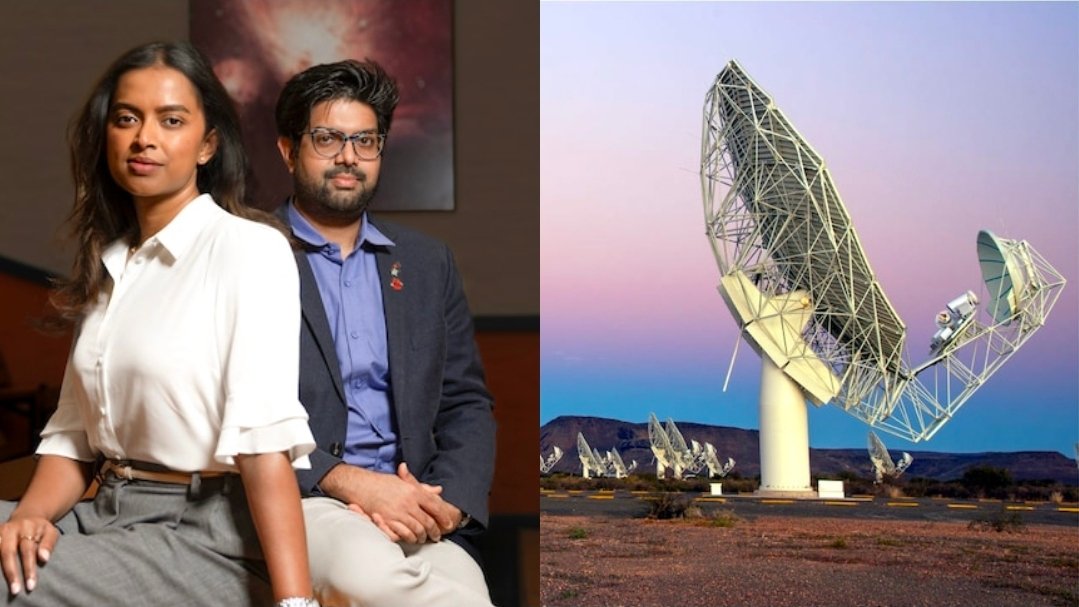
COLOMBO, October 9, 2026 — Sri Lankan scientist Themiya Nanayakkara has contributed to a landmark international astronomy discovery involving the oldest fast radio burst ever recorded, a signal originating from a galaxy approximately 10 billion years ago that could help scientists unlock new insights into the evolution of the universe.
The discovery, published in the scientific journal Science, offers researchers a new way to investigate the distribution of ordinary matter across the universe and understand how galaxies evolved over billions of years.
Nanayakkara was a co-author of the research led by University of Sydney astrophysicist Dr. Manisha Caleb. The international team investigated a powerful radio signal designated FRB 20240304B, first detected in 2024 by the MeerKAT radio telescope in South Africa.
Using NASA’s James Webb Space Telescope, researchers traced the burst to a small, actively star-forming galaxy that existed when the universe was approximately three billion years old, around 10 billion years before the present.
Fast radio bursts are intense flashes of radio waves that last only milliseconds but can release enormous amounts of energy. Although astronomers have detected many such signals, their exact origins remain uncertain. One leading explanation links them to magnetars — highly magnetised neutron stars formed from the remnants of massive stars.
The discovery is particularly important because these distant signals can act as probes of matter between galaxies. As radio waves travel across vast cosmic distances, they interact with material along their path, allowing scientists to investigate matter that may otherwise be difficult to observe directly.
Researchers believe fast radio bursts could help map the cosmic web, the immense network of filaments and structures that connects galaxies and contains a substantial share of the universe’s ordinary matter. Studying these signals may help address questions about how matter is distributed across space and how cosmic structures developed over time.
Speaking to Australia’s ABC News, Dr. Caleb described the finding as extraordinary, highlighting the immense length of the signal’s journey through the universe before reaching Earth.
For Sri Lanka, Nanayakkara’s contribution highlights the role of local scientific talent in international research addressing some of astronomy’s most complex questions. Participation in such collaborations also demonstrates how researchers can contribute to discoveries that rely on advanced observatories, international expertise and cutting-edge scientific technology.
The research team expects the findings to support further investigations into the origins of fast radio bursts and their potential to reveal the universe’s hidden matter, offering astronomers another tool for studying the history and structure of the cosmos.