
Higher Wages, Lower Living Standards: Sri Lanka’s Real Take-Home Pay, 2017–2026

COLOMBO, November 8, 2026 — Formal-sector gross wages, on the EPF-based index, rose 131.8% between January 2017 and March 2026, ahead of the 114.9% rise in consumer prices. Employees are still worse off. After 8% EPF, PAYE/APIT (PAYE became APIT in 2020) and inflation, only someone starting near LKR 100,000 a month is ahead, by 7.1%, and the loss deepens with pay to −17.0% at LKR 1 million.
The cause is the tax schedule. Wage growth is identical for everyone here, inflation erodes every rupee equally and EPF takes a flat 8%. Only PAYE/APIT varies with income, because relief is fixed in rupees and bands are not indexed. In the top band LKR 1.79 of gross pay restores each LKR 1 lost.
The measure, and the deductions
The EPF-based index best captures real private-sector incomes: monthly, January 2017 = 100, built from contribution records rather than minimum wage rates, though it excludes overtime, bonuses and non-members. Take-home pay runs from gross wage, less 8% EPF, less PAYE/APIT, deflated by the CCPI. Relief and bands have changed four times since 2017, most sharply in January 2023.
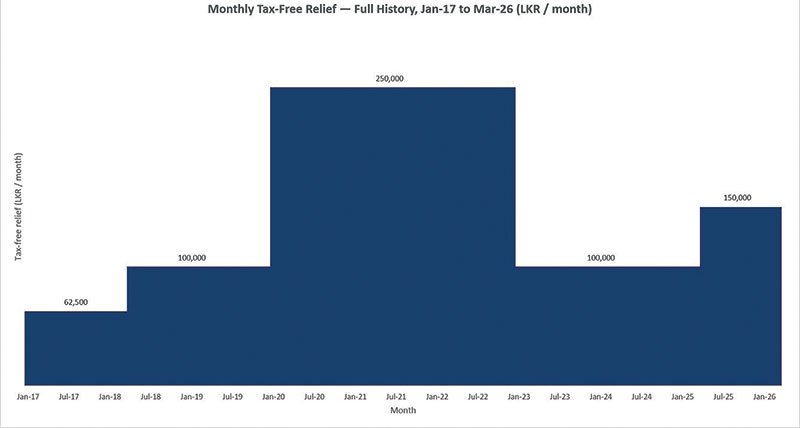
Chart 1:
Wage growth beat inflation, but not taxation
The model follows one employee whose January 2017 salary moves with the index, less 8% EPF and the tax then in force, deflated to 2017 rupees: 111 months, five tax regimes.
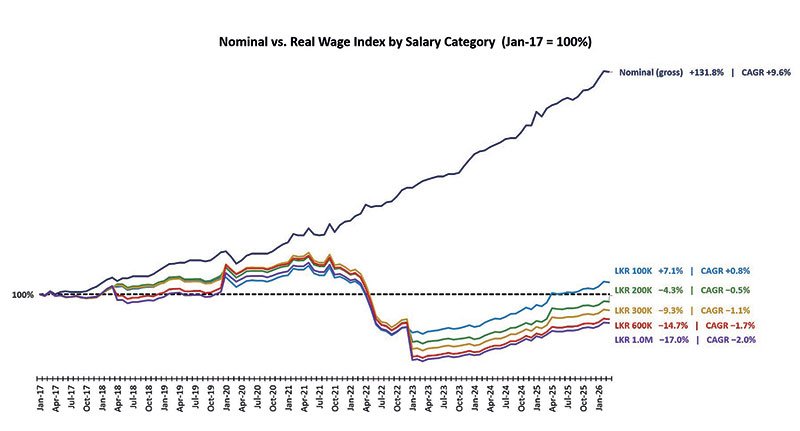
Chart 2:
Nominal pay ends up 131.8% (CAGR 9.6%); the best real outcome is +7.1%, the worst −17.0%. Even at best, 94.6% of that growth never reached the employee.
The lines hold near 100% to 2019, peak 10 to 15% higher around mid-2021, then fall below 100% from mid-2022 as crisis inflation outran wages. January 2023 adds a second step down, from tax reform rather than prices, and is where the five separate in order of salary. Bracket creep widens the spread to 24.1 points by March 2026; only the LKR 100,000 line has regained 2017 levels.
Table 1
Table 2
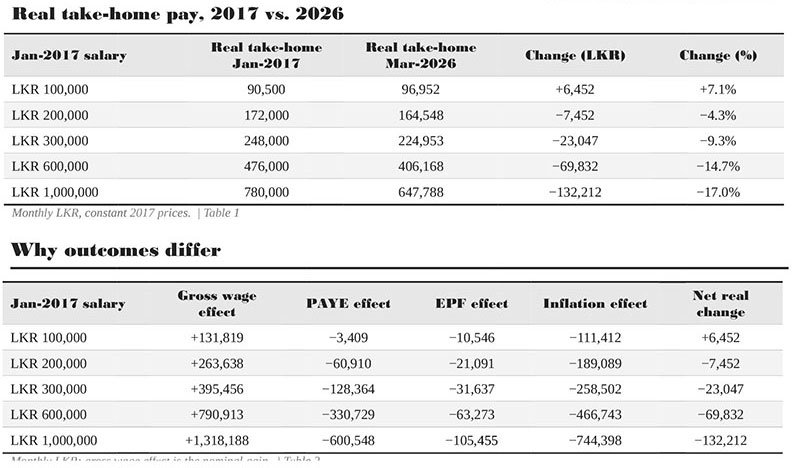
Gross wages rose 131.8% for everyone, proportional to starting salary, so growth alone creates no inequality. Inflation takes 56% to 85% of that gain but is neutral in percentage terms: each rupee lost 53.5% of its value.
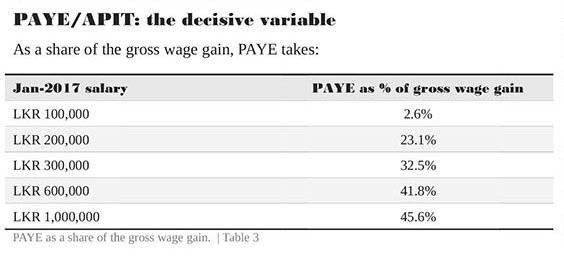
Table 3
The LKR 100,000 employee gives up 2.6% of their pay rise to tax, the LKR 1 million employee nearly half. Relief is fixed in rupees: the LKR 150,000 monthly threshold covers 65% of the first 2026 salary and 6.5% of the second. Nothing is indexed, so effective rates rose from 6.0% to 15.7% at LKR 200,000 and from 14.0% to 32.0% at LKR 1 million. January 2023 cut annual relief to LKR 1.2 million, narrowed bands to LKR 500,000 and doubled the top rate to 36%; relief returned to LKR 1.8 million in April 2025. EPF takes a neutral 8% from everyone.
Restoring 2017 purchasing power
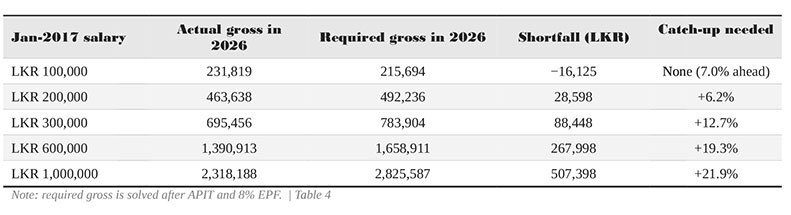
This costs nothing at the bottom and 21.9% more at the top, climbing with salary for one reason: PAYE/APIT. The calculation runs backwards: 2017 real take-home pay scaled by inflation, then solved back to the 2026 gross needed after tax and EPF.
Every category from LKR 200,000 up already sits in the 36% band, so a catch-up rise is taxed at 36% and cut 8% for EPF, leaving 56 cents in the rupee. Restoring LKR 1 of spending power costs LKR 1.16 in the 6% band, LKR 1.35 at 18%, LKR 1.47 at 24%, LKR 1.61 at 30% and LKR 1.79 at 36%.
An across-the-board rise pegged to inflation is not neutral: it holds the lowest paid level, leaves the LKR 200,000 employee 14.5% short and each higher band further behind. The remedy is graded increases, or relief and bands indexed to inflation.
Conclusions
· Wage growth was strong: 131.8% against 114.9% inflation. The labour market is not the problem.
· Inflation is the largest deduction, but it cuts everyone equally in percentage terms.
· PAYE decides who wins and loses. It is the only force that varies with income, and that is tax design.
· EPF is large but neutral, deferred saving rather than a loss.
· Only those starting at LKR 100,000 are ahead. Above that, nine years of above-inflation wage growth still left people poorer.
The writer is a CFA charterholder and Chief Investment Officer at a Colombo-based wealth management firm. EPF-based wage index data: derived from official Central Bank of Sri Lanka publications.